
























Church leaders care deeply about people.
That’s not the problem.
Most pastors, ministry staff, and key leaders are not lacking compassion. They are not sitting around hoping someone else will notice the person who is drifting, the family that quietly stopped attending, or the volunteer who is beginning to burn out.
The issue is not care. It is visibility.
In most churches, leaders cannot see clearly enough to respond in time.
That distinction matters.
Many churches say they want better follow-up. They want to reach out more consistently. They want to care for people in a way that feels personal, pastoral, and meaningful. Those are good desires, but they sit downstream from the real challenge.
Church leaders, you cannot shepherd what you cannot see.
That is why I come back to a framework shaped by patterns I’ve seen across churches of every size. Every church is already operating within one of these stages. Most just don’t have language for it.
The 4 C’s Of Data-Driven Discipleship:
Conviction
Collection
Clarity
Care
These are not abstract ideas. They form a progression, and for most churches, the pipeline breaks long before care ever happens.
If we are going to lead people well, it will take more than good intentions. It will take rhythms that help us see people clearly, understand what is happening in their lives, and respond with purpose.
Conviction Comes First
Before a church improves a process, it needs a shared belief.
Leaders have to believe that seeing people early is part of shepherding. Noticing is not administrative work detached from ministry. It is ministry. It is one of the ways we love people well.
But conviction does not stop there.
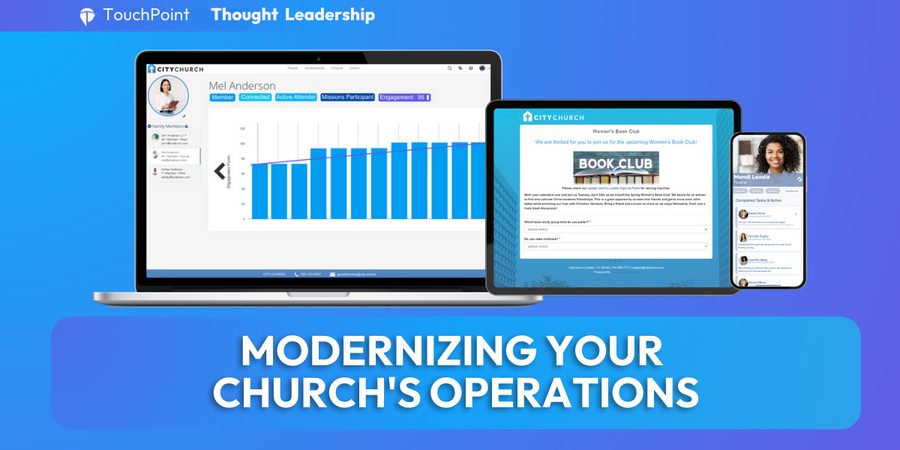
Leaders also must believe that data can be a meaningful tool in that work. Not as a replacement for relationship, but as a way to see what would otherwise go unnoticed. When used well, data does not distance us from people. It helps us pay attention to them.
For some churches, this is the first shift that needs to happen. They may already have information somewhere, but they have not yet built a culture that treats visibility as a pastoral responsibility. Instead, they rely on memory, instinct, or the assumption that people will raise their hand when they need help.
Sometimes they do. Many times, they do not.
People drift quietly. They disengage gradually. They stop attending before anyone realizes they are gone. They move from connected to discouraged without ever announcing it.
Shepherding gets stronger when leaders stop waiting for a crisis and start paying attention earlier, and when they are willing to use the tools that help them do it.
That is why conviction matters. It grounds the rest of the work.

Collection Needs To Be Meaningful
Once a church believes this matters, the next question becomes: what are we actually paying attention to?
Collection is not about obsessing over numbers. It is about capturing meaningful ministry signals that reveal where people are and how they are engaging.
That may include attendance, group involvement, serving, giving, registration activity, or other indicators that help leaders understand whether someone is moving toward deeper connection or beginning to slip through the cracks. The goal is not to reduce people to data points. It is to surface patterns that would otherwise go unseen.
This is where many churches quietly break down.
The information often exists, but it is scattered. Reporting is manual. Different ministries are tracking different things. Staff members each hold pieces of the story, but no one can see the whole person.
So, the team does what they can. They rely on conversations, memory, and instincts to fill in the gaps.
That is not a system. That is guesswork.
And guesswork usually catches people too late.
Meaningful collection changes that. It creates conditions for timely care. It moves churches from “I had no idea” to “I’m glad we caught that early.”
Clarity Is The Hinge
This is where many churches get stuck.
They have conviction.
They are collecting data.
But leaders still cannot see what actually matters, or what requires action.
So, information stays information. It never becomes insight.
“Clarity is the hinge between data and discipleship.”
A report is not the goal. A dashboard is not the goal. A list of names is not the goal.
The goal is simple: helping leaders understand what they are seeing and what they should do next.
Who is new?
Who is drifting?
Who is disconnected?
Who might need encouragement, a conversation, or a personal invitation back into community?
If leaders cannot answer those questions quickly and confidently, the system is not creating clarity. It is creating noise.
And noise gets ignored.
When information is hard to find, hard to understand, or too overwhelming to interpret, it sits unused. Not because leaders do not care, but because the signal is buried.
Churches do not need more data. They need visibility that leads somewhere.
Clarity is what turns insight into action.
Clarity is what makes care possible.
Care Is Still The Point
This is where all of it should lead:
A phone call.
A text.
A conversation after service.
A leader reaching out because they noticed a change and chose to step in.
Care is the point. It always has been.
But care does not happen by accident. It is not sustained by sincerity alone. Care is built on rhythms, supported by systems, and reinforced through shared follow-through.
This is what it looks like when insight turns into action.
When leaders see clearly, they respond intentionally, and when that happens, people feel it.
They feel seen.
They feel supported.
They experience the Church not just as a place they attend, but as a body that sees them and cares.
That kind of care carries weight.
It reaches people before they know how to ask for help.
Two Multipliers that Sustain The Work
There are two multipliers that often determine whether this actually works.
The first is coaching.
Many staff members and volunteers care deeply, but they are not always confident initiating shepherding conversations. They do not know how to begin. They worry about saying the wrong thing. They sense the need but hesitate in the moment.
So, care stalls.
Care without coaching is clumsy.
Teach your team how to navigate shepherding calls well.
Coaching helps leaders grow in both confidence and competence. It gives them language, posture, and practice. Care is not just a natural empathy some have. It is a responsibility and a skill that can be developed and strengthened over time.
The second multiplier is consistency.
This is where many churches quietly break down.
Not because people do not care, but because good intentions are not a system. Without clear ownership and simple rhythms, follow-through becomes optional.
Without consistency, care becomes rare.
Consistency is not about pressure for pressure’s sake. It is about clarity, ownership, and encouragement. It creates regular moments where leaders can see, respond, and follow through together.
When those rhythms are in place, something shifts.
Care moves from reactive to intentional.
From occasional to consistent.
And over time, that consistency builds trust.
Start With A Free Church Health Assessment
Church leaders are carrying a lot. It can be difficult to know where to focus first.
The Church Health Assessment gives you a simple starting point. In a matter of minutes, you can step back, evaluate key areas of church health, and gain perspective on where your ministry is strong and where more attention may be needed.
Whether you are assessing engagement, structure, follow-up, or broader discipleship rhythms, this is a practical first step toward healthier ministry.

A More Faithful Way to Steward God’s People
This conversation matters because many churches are trying to solve the right problem at the wrong point in the process.
They are asking, “How do we care better?” That is a worthy question, but the more honest question is, “Can we clearly see the people we are called to shepherd?”
If the answer is no, the next step is not shame. It is clarity.
Start with conviction. Build meaningful collection. Create clarity that turns insight into action. Then follow through with care.
This is not cold leadership. It is faithful leadership.
It is not replacing shepherding with systems. It is building systems that support shepherding.
To steward people well, we have to be willing to see them when they need us most.
In a time when many leaders feel stretched, reactive, and overloaded, that kind of clarity is not a burden. It is a gift.
So start by identifying where things are breaking down at your church.
Is conviction missing?
Is collection inconsistent or unfocused?
Do you have information without clarity?
Or insight without ownership to follow through?
Wherever the friction is, that is where the work begins, and often, it is where the breakthrough is waiting.
About The Author
Ronee de Leon serves on the Senior Leadership Team at TouchPoint and brings deep ministry experience, a heart for the local church, and a passion for helping leaders care for people well.
We are grateful for the wisdom she shares with churches and for the way she equips leaders to think more clearly about shepherding, follow-up, and discipleship in a complex ministry environment.
The 4 C’s of Data-Driven Discipleship is a framework developed by Ronee de Leon.
We encourage you to connect with her on LinkedIn and Instagram as the source of this valuable resource.