





















When Fellowship Bible Church in Tennessee began preparing for a new church management system, they were not only making a software decision. They were asking a bigger leadership question:
How can a church organize its people, processes, and ministries so the whole body works together with clarity?
For Andrea Riley, Manager of Church Database, that question was already familiar. She has served on staff for 19 years and spent years helping clean up data, support ministries, and bring stronger consistency to the church’s systems. Before moving to TouchPoint, FBC had been using FellowshipOne for more than two decades and spent years evaluating what kind of platform could support their next season of ministry. As Andrea explained, they needed “somebody that could move with us for the next 20 years.”
But one of the most important pieces of Fellowship Bible’s successful implementation began long before the church signed with TouchPoint.
It began the year prior with a group called MOC.
From Ministry Silos To Shared Ownership
At Fellowship Bible, MOC stands for Ministry Operations Council. The group was created pre-Covid as a way to bring ministry administrators and central service leaders together to solve operational challenges across the church.
The main purpose was to ask this question: “How are we going to solve operational problems?” FBC already knew how to do ministry, strategy, and care well. But like many churches, they needed a more consistent way to address the processes, tools, communication rhythms, and systems that support ministry behind the scenes.
Thus, the MOC was formed and became a table that included representatives from every ministry and central service area. Today, Fellowship Bible has 16 people involved in the MOC. They meet once a month for 2 hours, and no other staff meetings are allowed to be scheduled during that time. Even if a ministry does not have a dedicated MOC representative, someone is connected by proxy so every area of the church can remain informed and aligned.
The goal was never to create another committee with authority over ministries. It was to assemble a group that leads through conversation, collaboration, and influence. They identify problems, share best practices, create processes, and bring recommendations to executive leadership when a decision needs to be made at that level.
That distinction matters.
The MOC team is not there to slow ministry down. It exists to help ministry move forward with greater unity.

Giving Ministry Admins A Seat At The Table
One of the clearest descriptions Andrea gave of the MOC role is that these are the people who help execute strategy. When ministries are planning or new ideas are discussed, MOC members are the ones that raise their hands and say, “How?”
That simple question has become one of the most valuable contributions the MOC team brings to FBC.
How will this affect other ministries?
How will this affect childcare?
How will this affect communications?
How will this affect the church body?
Instead of each ministry operating only within its own lane, the MOC team began helping staff “peek over the fence” and see others. They started noticing when multiple ministries had large events on the same day. They began asking which processes could be shared, whether communication could be coordinated, and how the church could serve people better by thinking more holistically.
Fellowship Bible’s internal tagline for the group captures it well: “executing strategy for the benefit of the whole.” Not self-serving, not near-sighted, but humbly and authentically for the whole church.
Bring Your Ministry Data Together
Healthy ministry alignment starts with shared clarity. TouchPoint helps large churches centralize people data, ministry activity, giving, communication, and discipleship pathways so staff can serve with confidence.
Why Alignment Matters When Change Comes
Because FBC had already built a culture of shared ownership through the MOC, their transition to TouchPoint had a stronger foundation. The MOC was not created for a ChMS conversion, but it became a key reason the implementation had energy, buy-in, and cross-ministry support.
“The number one thing that the MOC brought to implementation was the excitement and the buy-in,” Andrea said.
That buy-in mattered because the MOC representatives were also the high-volume users. They were the people who would be working in the system regularly, supporting ministries, answering questions, and helping staff adopt new processes. Instead of Andrea having to convince each department one by one, she already had a group of trusted operational leaders who were engaged, informed, and ready to learn.
“My number one cheerleaders have been the MOCs,” Andrea said.
They watched training videos. They brought excitement back to their ministries. They helped staff understand what TouchPoint would make possible. And because Fellowship Bible had already surveyed ministry teams about what they disliked, what they wished could change, and what they would want “if they could wave a magic wand,” the church was able to connect TouchPoint features directly to real ministry needs.
For larger churches especially, that kind of shared ownership can make a significant difference. A system change cannot rest on one person’s shoulders. Fellowship Bible’s MOC structure helped spread knowledge, confidence, and ownership across the organization before the implementation pressure hit.
Seeing The Database As Someone’s Story
While the MOC team helped Fellowship Bible standardize processes, Andrea is careful to keep the focus on people.
She shared that one of her recurring messages to staff was to stop viewing the database as a “glorified Rolodex.” Instead, they began talking about the database as a place that helps tell someone’s story.
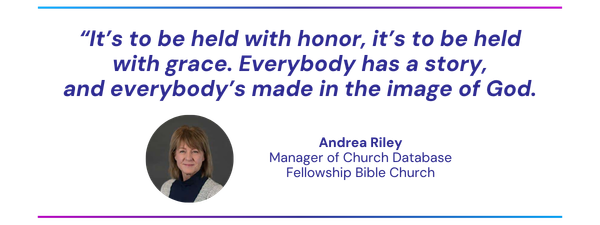
That perspective changes the way a church thinks about data.
A name in the database represents a person.
A report can reveal an opportunity for care.
A cleaner process can help someone take their next faith step.
Better internal communication can help a person feel known instead of overlooked.
For FBC, this is one of the reasons that operations matter. The goal is not efficiency for its own sake. The goal is to support ministry with greater clarity, consistency, and care.
What Other Churches Can Learn
For churches that feel disjointed, siloed, or unsure how to create better staff alignment, Andrea’s advice is refreshingly practical: “Give it a shot. Give it a year.”
She encourages churches to bring the right people to the table, prepare well, and create space for ministry and operations leaders to work together. Over time, she believes churches will begin to see better internal communication, stronger trust, greater efficiency, and more effective ministry decisions.
Andrea also pointed out that churches should consider the experience of the “end user”—the person in the congregation. If ministries are sending overlapping communication, using disconnected processes, or operating in silos, the person on the receiving end may feel like the church does not know them well. But when ministries collaborate, the experience becomes more thoughtful and more personal.
The MOC team has helped FBC’s operational staff become problem solvers instead of task takers. That shift has built influence and trust across the organization.
A Tool For The Mission
Fellowship Bible’s implementation of TouchPoint Church Management Software is part of a larger ministry picture. Andrea shared that the church’s goal for the year is to fully implement TouchPoint in their ministry, not just get the system running. The deeper goal is to help each person in the congregation identify their next faith step on the discipleship pathway.
That is where the story becomes much bigger than software.
TouchPoint is helping provide the tool. The MOC team is helping provide the structure. Fellowship Bible Church is leading with the mission.
And for other churches preparing for a system change, the lesson is clear: successful implementation begins long before launch day. It begins when people are aligned, ministries are communicating, operational leaders are empowered, and the church keeps the church attendees at the center of every process.
Fellowship Bible’s story is a reminder that when operations serve ministry well, the whole church is better equipped to help people follow Jesus with their whole heart.
Where There’s A Feature, There’s A Story

Reducing Data Silos
Church at the Mill, SC
Discover how an integrated church management system can streamline tasks so you can focus more on discipleship.

Church-Wide Check-In
Broadmoor Baptist, MS
Do you want to know who attends your weekend services? See how Broadmoor Baptist set a culture of “know and be known”.

Genuine Customer Support
Indiana Avenue Baptist Church, TX
Does your church have a vendor or a true partner in ministry? Hear how relational partnership can impact ministry.